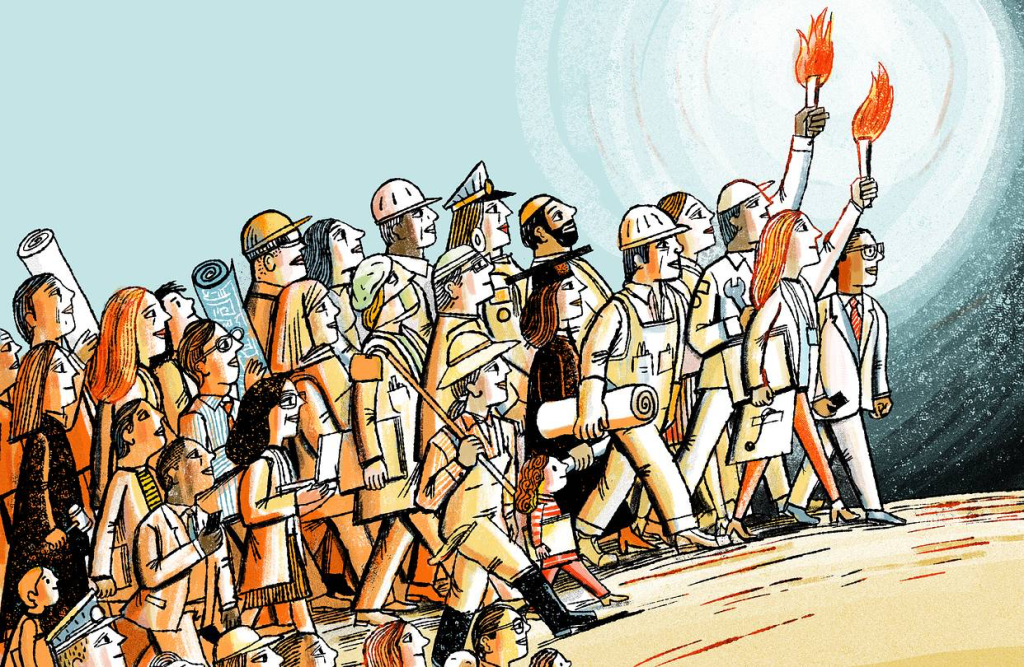
What Is Left When the Lights Go Out?

The contemporary left increasingly sounds like its old enemies.

Listen closely and the vocabulary feels oddly familiar. The world is fallen. Everything is structurally flawed. Anyone who touches power is complicit. Reform is a joke. Only total rupture can save us. Unless something pure arrives, the only honest attitude is disgust.

This used to be the language of priests and reactionaries, the language of original sin and a world beyond redemption, of waiting for a savior.

Now you hear it, almost word for word, in an influential strand of the intellectual left that sets the tone in media, academia and NGOs in North America and Western Europe, a milieu that perhaps no longer claims the Enlightenment as an ancestor. 

By the Enlightenment I mean the movement that took shape in the 18th century and defended the primacy of reason, science, and progress against oppression and superstition.

Much of the new mood traces back to the intellectual turn shaped by Foucault and Said — Foucault undermining faith in modern institutions, and Said casting universalism itself as a form of domination.

What follows is a brief sketch of what it looks like when that Enlightenment conviction fades, and a different, darker stream takes its place.


Reform vs. Original Sin

In the Enlightenment tradition, the starting point was never that the world was innocent. It was that the world was improvable.

States came out of conquest and war, yet they could be forced to obey constitutions. Economies were built on exploitation, yet they could be taxed, regulated and reshaped. Institutions were born crooked, but they could be pushed.

That spirit has been replaced, in many quarters, by something closer to a doctrine of original sin. Because the state has violent origins, any use of the state is treated as suspect. Because parliaments do not always deliver expected results, any parliamentary route is dismissed as naive. Because capitalism structures everything, any gain achieved within it is brushed off as a trick.

It is less political analysis than a secular version of “this world lies in wickedness”. 


Reformers vs. the Messiah

And once the world itself is treated as wicked beyond repair, the people who try to work within it start to look suspect too.

The Enlightenment idea also came with a sober view of the human beings who would have to change things. Reformers would never be saints. They would be quarrelsome lawyers, flawed parliamentarians, union organizers and civil servants who compromised when they had to and pushed when they could.

No one believed that the individuals who abolished slavery, extended the suffrage, built welfare systems or passed civil rights laws were spotless. The question was whether they sought change in the right direction.

Today, politics often sounds like a casting call for a savior. Anyone short of the Messiah is impure. Anyone who has not been perfect all along is beyond forgiveness.

This is not a politics of responsibility. It is a replay of a religious script in which the world is fallen, everyone in it is compromised, and only something from outside the system can set things right.


Hopeful Optimism vs. the World Beyond Redemption

When ordinary, flawed reformers are ruled out in advance, what fills the gap is not better politics but a growing conviction that politics itself is pointless.

Enlightenment optimism was never blind. It knew that people lie, that elites love their privilege, that violence runs through history. What it refused was fatalism.

The future was not guaranteed to be better, yet it was open enough that effort made sense. 

This was the spirit of Voltaire, who once joked that the most important decision one makes is “to be in a good mood.” He meant that hope is not naïveté but a discipline.

But a lot of left-wing talk now sounds more like end-times discourse. The climate is collapsing. Democracy is hollowed out. Capital always wins. Racism and patriarchy reproduce themselves in every reform.

These are real dangers. But the conclusion drawn is often not “we need a plan”, it is “any talk of improvement is a lie”.

Hope is treated as naive, even immoral. To say that something can get better is taken as downplaying the scale of the crisis. The only serious tone is despair. Anything less than a world revolution is just rearranging deck chairs.

Once you believe that, the craft of politics becomes almost impossible to justify. Why build coalitions with imperfect allies or bargain for half measures if the entire structure is damned?

It abandons the defiant hope that defined the Enlightenment at its best. 

And as that hope shrinks, so does the circle of people in whose name you are willing to speak.


Universalism vs. Particularism

The Enlightenment tradition, for all its flaws, insisted on a universal moral horizon. It claimed that all human beings share a basic standing as persons. It said there are standards that apply everywhere, even if the powerful constantly break them.

That is what gave it the courage to criticize priests, nobles and kings in the name of reason.

Some within the contemporary left are now deeply wary of this language. It has grown much more comfortable speaking only in the name of particular groups and identities. Sometimes that is needed when the rights and liberties of minorities are under attack.

But when particularism hardens into habit, something else happens. Practices and authorities inside a community that would once have been criticised from a universal standpoint are now carefully handled as “their culture”. The reflex becomes “who are we to judge” whenever harm is justified as traditional or authentic for a Western audience.

The claim that only insiders can speak and that no external standard has any authority is an old one. When the left repeats it in more sophisticated language, it leaves dissidents inside those worlds without a common vocabulary to appeal to.

A tradition that once tried to speak for humanity ends up sounding like just another guarded tribe, which is exactly what it once opposed.


A left that sounds like what it once opposed

What needs to be reclaimed is not the mythology of perfect progress, but a few simple propositions.

Reform is possible even when origins are questionable. Reformers will always be compromised people and that is human. This world, as it is, still contains space for changes that matter. Human beings in very different places still share enough to justify speaking of common values.

Those are Enlightenment claims in their most modest form. Let go of them, and you do not get a stronger progressive movement. You get a movement that talks like a church with shrinking numbers. And the work of actually governing the world is left to those who thrive in the dark.not get a stronger progressive movement. You get a movement that talks like a church with shrinking numbers. And the work of actually governing the world is left to those who thrive in the dark.

Leave a comment