
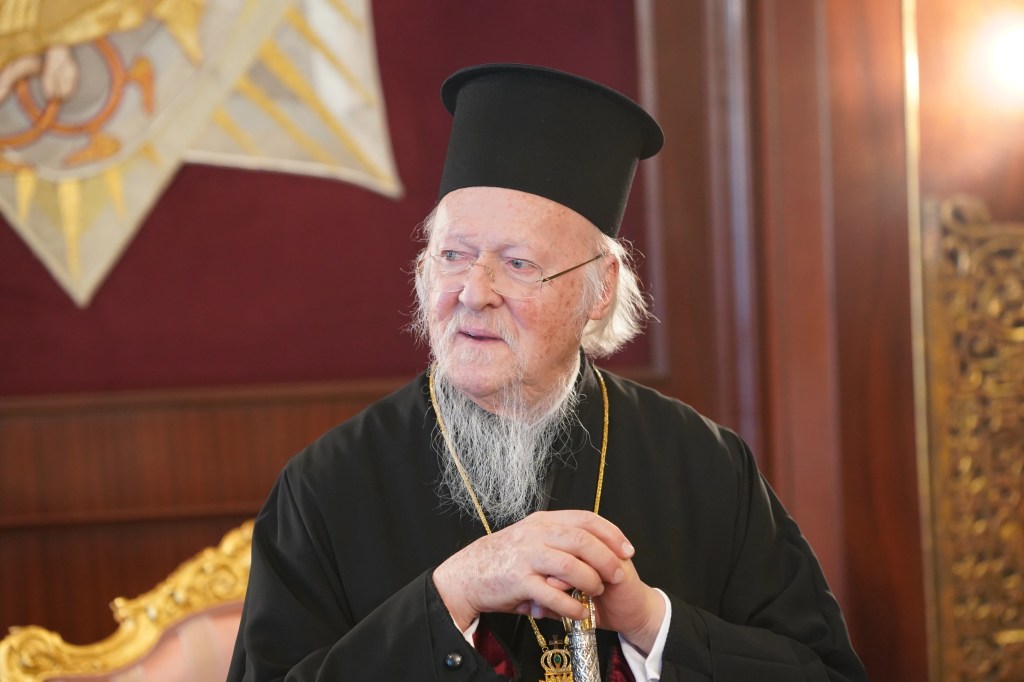
When Pope Leo XIV and Ecumenical Patriarch Bartholomew walk together through the ruins of Nicaea this week to mark the 1,700th anniversary of the first ecumenical council, the symbolism will be hard to miss.
Seventeen centuries ago, bishops gathered here to answer a theological crisis posed by Arianism, the teaching that Christ was not fully divine but a lesser, created being.
Today, the ancient heretical impulse resurfaces — the urge to drag what is transcendent down into the realm of the immanent.
Call it the heresy of Putinism, a theology in which Christ is no longer the Son of God who stands above empires, but at the service of one empire in particular.
And the man walking alongside the Pope at Nicaea has spent years warning against this distortion.
Meeting Bartholomew, the “Green Patriarch”
I have met Bartholomew only once, briefly.
On a quiet Sunday in the Phanar, at the monthly communion service in the Patriarchate, I found myself in the same narrow hallway as this man whose title, “Ecumenical Patriarch of Constantinople,” sounds like something out of a Byzantine chronicle.
We exchanged a few words and a smile.
I am, by any reasonable standard, ardently secularist. I am not religious, not nostalgic for ancient times, and not in the market for spiritual fathers.
Yet even to me, Bartholomew stands out as an exemplary human being: soft-spoken, intellectually serious, and humble.
For three decades he has been the ‘Green Patriarch,’ championing climate action long before it was fashionable in Rome or Brussels.
He speaks of climate change not as an abstract environmental issue but as a moral and spiritual crisis, a matter of justice between living humans and future generations.
He was honored as a “Champion of the Earth” by the UN Environment Program and praised by Pope Francis as a model in Laudato Si’.
He is the man who will stand next to Leo XIV in Nicaea, a quiet, morally persuasive figure who spent years talking about protecting nature when most clerics were busy condemning gays and abortion.
Which leads directly to the theology emerging from Moscow.
The Heresy of Putinism
Under Patriarch Kirill, the Russian Orthodox Church has bound itself tightly to Putin’s authoritarian regime. The war in Ukraine has been blessed as a holy war, a defence of Holy Russia against globalism and Western decadence.
Bartholomew has condemned this alliance openly, accusing the Moscow Patriarchate of siding with Putin and promoting Russian imperial ideology as a cover for aggression.
Putinism makes Christ less than transcendent, reducing Him to a decorative icon for imperial ambition.
Where Nicaea insisted that Christ is of one substance with the Father, the Putinist creed quietly revises the formula: Christ is of one substance with the Flag.
This backdrop gives unusual weight to the meeting in Nicaea.
A New Nicaea Without a Council
The commemoration in Nicaea is not an ecumenical council. It will not issue canons or write a new creed.
But it is a kind of anti-heresy gesture, a staged answer to the weaponization of Christianity in Moscow.
Pope Leo XIV, in his apostolic letter on the Creed published ahead of the trip, presents Nicaea as a reminder that Christians across confessions still share a common doctrinal center.
The Vatican’s focus is clear. The Pope seeks to give a message of Christian unity at the anniversary of a council that defined the faith at a time of fracture.
For Bartholomew, this is more than a nice photo-op with a new pope. Since granting autocephaly to the Orthodox Church of Ukraine in 2019, he has been in open conflict with Moscow.
Moscow broke communion with Constantinople and framed him as a Western agent. The Orthodox world is effectively in a slow-motion schism.
In Nicaea, Bartholomew appears not as the lonely patriarch ostracized by Moscow, but as Rome’s principal Orthodox partner. It is a soft alignment between old rivals.
But Bartholomew’s ability to lead this spiritual fight partly depends on something entirely local: the simple ability to train new clergy.
Turkey’s Halki Question: A Just Demand, a Secular Dilemma
At home, Bartholomew’s long-running cause has been the reopening of the Halki Theological School on Heybeliada, Istanbul.
The seminary trained generations of Orthodox clergy, including Bartholomew himself, before it was shut down in 1971 when Turkey’s Constitutional Court effectively banned private higher theological education.
Since then, Halki has become yet another example in the argument that Turkey mistreats its Christian minorities.
Today, with the buildings carefully restored and Pope Leo’s visit focusing new attention, hopes are rising again to reopen it.
I have nothing but sympathy for this demand. A modern, self-confident republic should not fear a small seminary that educates a tiny minority.
But there is a genuine secular dilemma buried here, one that many liberals hesitate to voice.
If the government reopens Halki, it will almost certainly not be an Orthodox exception. It will require bending or reinterpreting the framework for private religious higher education.
And in Turkey, any hole opened in that wall is immediately exploited by the dense network of political Islam, a movement far larger and more organized than the Greek Orthodox community.
The fear is simple. Relaxing the law for Halki may give Islamists an opportunity to demand parallel institutions, not theological academies but a whole network of alternatives to modern higher education.
The already heavily wounded secular higher-education system would face yet another wave of pressure.
So we are caught in a paradox.
The just thing to do, reopen Halki, may unintentionally strengthen forces determined to dismantle secular education altogether.
There is no clean way out of this paradox.
If a state cannot design a narrowly tailored, transparent legal regime that protects a small seminary without turning every religious movement into a quasi-university franchise, the problem is not Bartholomew.
The problem is the thin ice that Turkish secularism walks on.
Institutional measures that were meant to protect us have grown increasingly frail.
Whether in Moscow’s war theology or in Turkey’s secular anxieties, the controversy of Arianism remains relevant: the sacred is pushed down into the domain of the immanent.
The forms change, from creeds to constitutions, from icons to slogans, but the temptation endures. In this sense, Nicaea remains unfinished business.
 Sinan Kircova
Leave a comment